
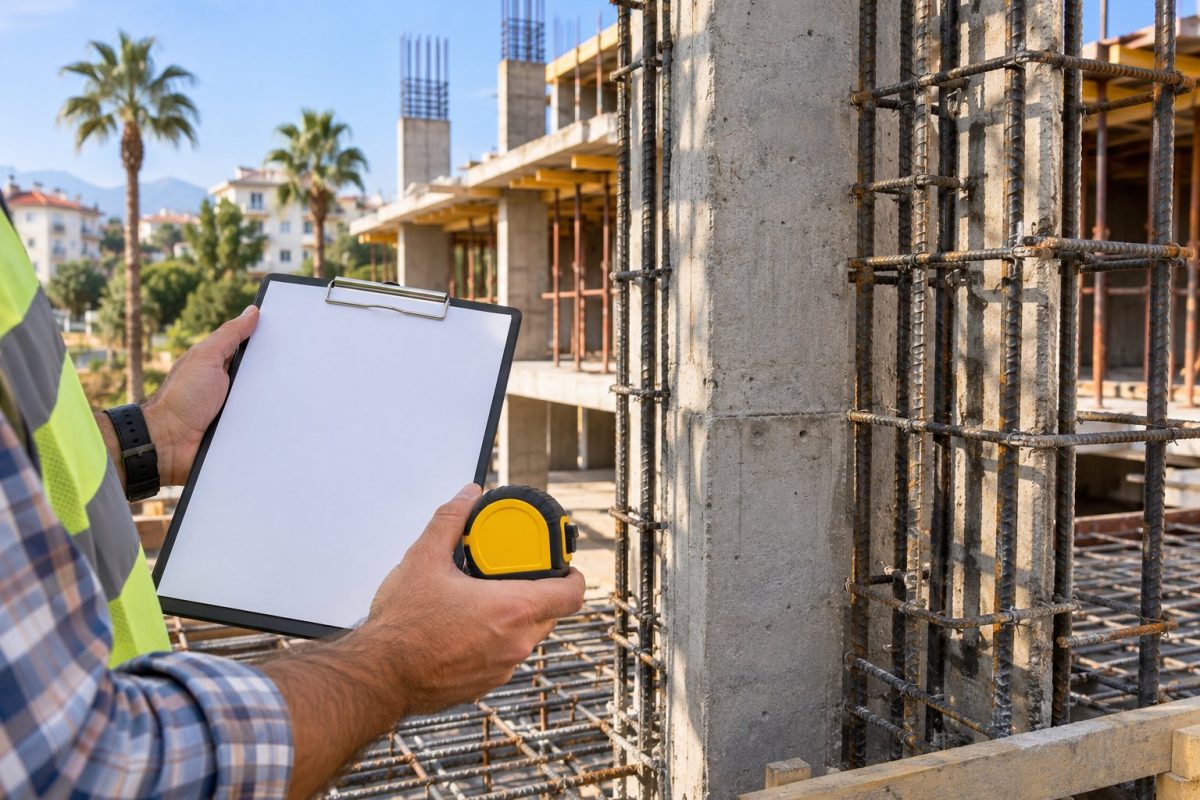
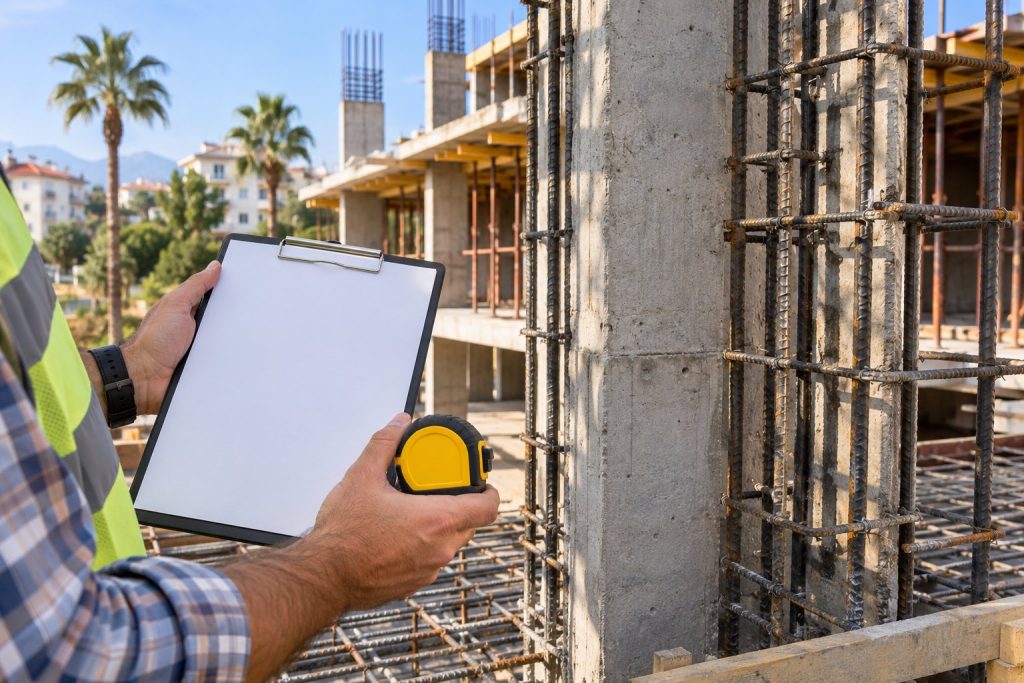
When foreign buyers look at apartments in Antalya, one question comes up again and again: should I buy a new build or a resale property? Location, size and budget matter, of course. But in Turkey the real difference lies in which rules the building was designed to and how its construction was checked.
Kendirciler İnşaat has been building in Antalya since 1985, and in Konyaalti’s Liman and Hurma neighbourhoods since 1999. Here is what we, as a developer, would look at before choosing between the two.
New build vs resale at a glance
| New build | Resale | |
|---|---|---|
| Earthquake code | Current code (TBDY 2018) if permitted from 2019 on | 1975, 1998 or 2007 code, depending on the year |
| Independent inspection | Mandatory, with recorded reports | Often none for buildings from before the early 2000s |
| Legal liability | Developer and inspection company are liable | Liability periods have usually expired |
| What you see | Off-plan: the apartment does not exist yet | You see the building, street and neighbours |
| Moving in | You may wait for completion | Usually straight away |
Why the year of construction matters
Turkish buildings are designed to the earthquake code in force when their building permit was issued. The code has been tightened after every major earthquake:
- 1975 code: weak by today’s standards.
- 1998 code: introduced just before the 1999 earthquakes, with much stricter rules on ductility and reinforcement.
- 2007 code: updated calculation methods; minimum concrete class C20.
- Turkish Building Earthquake Code (TBDY 2018): in force since 1 January 2019. Seismic hazard is now calculated for the exact location of each building rather than for a whole region, and the minimum concrete class rose to C25.
A code is only a rule on paper. Whether a building actually meets it depends on the ground, the concrete, the steel and the workmanship — which is why inspection matters as much as the year.
Building inspection: who checked, who is liable?
Under Turkey’s Building Inspection Law (No. 4708), every new building is supervised by a licensed building inspection company registered with the Ministry of Environment and Urbanisation. It reports on every stage, from the soil survey and foundations to each concrete pour and the reinforcement; concrete samples are tested in a laboratory.
By law, the inspection company remains liable from the date of the occupancy permit:
- for 15 years for the load-bearing structure (foundations, columns, beams, slabs);
- for 2 years for non-structural parts.
On top of that, a consumer who buys a home from a developer can claim for hidden defects for 5 years from handover under Turkey’s Consumer Protection Law (No. 6502).
With a resale apartment these protections have usually run out, so the checks are up to you.
Documents to ask for
New or resale, check these before you sign anything:
- Occupancy permit (iskan): confirms that the building was completed according to its approved project and passed inspection. Without it, connecting electricity, water and gas can be a problem.
- Title deed type: a kat mülkiyeti deed means the building is complete and has its occupancy permit. A kat irtifakı deed means the permit may not have been issued yet — always ask why.
- Building registration certificate (yapı kayıt belgesi): issued under the 2018 zoning amnesty to register unauthorised parts of a building. It does not prove earthquake safety and is not a substitute for an occupancy permit.
- Approved project: available from the municipality. It shows whether the apartment, balconies and roof match what was approved.
What to check in a resale apartment
A resale apartment can be a good choice: an established neighbourhood, neighbours you can meet, and you know exactly what you are getting. But look carefully at:
- The year of the building permit. Be more cautious with buildings from before 2000.
- Changes on the ground floor. Were columns cut or walls removed to make room for a shop? Interference with the load-bearing structure is one of the biggest risks.
- Cracks and rust stains on columns and beams. Exposed or rusting reinforcement is a serious warning sign.
- Damp and leaks. Moisture in the basement or under the roof slowly corrodes the steel inside the concrete.
- An independent survey. If in doubt, have a civil engineer inspect the building. With the owners’ consent, a core test of the concrete can also be done.
What to check in a new build
A new build gives you the current code and legal protection, but don’t buy blindly:
- The developer’s track record. Visit buildings they completed years ago and talk to the residents.
- Building permit and inspection company. Ask for the permit date and the name of the inspection company.
- Soil survey. Especially important on former river beds and filled ground.
- Contract and completion date. If you buy off-plan, the contract should clearly state the completion date, what happens if it is late and the payment plan.
- Handover. Inspect the apartment thoroughly before taking the keys — our apartment handover checklist walks you through it.
Which suits you?
- A new build is the more comfortable choice if you plan to live here for many years and value the current earthquake code and legal protection.
- A resale apartment makes sense if you want a particular street or need to move in straight away — provided you check the year, the documents and the building’s condition carefully.
Frequently asked questions
Is a new build safer than a resale apartment in Turkey?
As a rule, a new building permitted from 2019 onwards and supervised by an inspection company is considered safer, because it was designed to the current earthquake code. What really decides it, though, is the ground, materials and workmanship: a well-built older building can be sounder than a badly built new one.
How do I find out which earthquake code a building was designed to?
Look at the date of the building permit. A permit from 2019 onwards means TBDY 2018; 2007–2018 means the 2007 code; 1998–2007 means the 1998 code.
Can I buy an apartment with a kat irtifakı title deed?
You can, but find out why there is no occupancy permit yet. If the building has only just been completed, the process may still be under way. If the permit has been missing for years, there may be a problem such as deviation from the approved project.
How long is the building inspection company liable?
From the date of the occupancy permit: 15 years for the load-bearing structure and 2 years for non-structural parts.
Need help choosing an apartment?
We have completed around 30 projects in Konyaalti since 1999 — see them on our Projects page. If you are weighing up a building or a project, ask us in English on WhatsApp or Telegram.
